Sunday, May 14, 2006

Incredible !ndia


India has been ranked 5th among the world’s tourists’ hot spots and also the fastest growing tourism, 8.8% annually by World Travel and Tourism Council. WTTC also projected India as one of the, emerging tourism markets having potential of $ 24 billion annual foreign exchange earnings through tourism by 2015.

The year started with the launching of ‘Atithi Devo Bhava’ on January 19th, a social awareness campaign aimed at providing the inbound tourists the sense of being welcomed by, and to the country. The components of the campaign are orientation and training to taxi drivers, guides, immigration officers, tourist police and other personnel directly interacting with the tourists. Delhi, Mumbai, Goa, Hyderabad, Jaipur, Agra and Augrangabad were covered in first phase. 26,000 service providers were given training in these cities. After successful completion of first phase, second phase of the campaign launched in November, 2005 with the target of training and sensitizing 75,000 personnel by the end of next year under the campaign.


Truly, an amazing effort from the Tourism department to mobilize mindsets to give a new face lift to the Indian Tourism industry. Sadly, though they have still a long way to go. And, if one would like to reason why? Here, is an answer to that:

This is what is being charged as the entry fee to a historic monument from the "God-like" foreign tourists. Why this distinction is being made? And what is the logic of this distinction......origin, religion, caste, creed? And should this distinction be applied to those who have transcend international boundaries, just to know what makes India incredible? And, whats that extra thing that a foreign tourist get to see...which an Indian doesn't:

What makes me really surprised, is the fact that the same is being charged at the venue of one of the Other 7 Wonders of the World....and yes you guessed it right...... "The Taj Mahal".

There are more things internal to our mindset which needs to be changed to make "India" truely an "Incredible India", a home is made by the people who live in it.

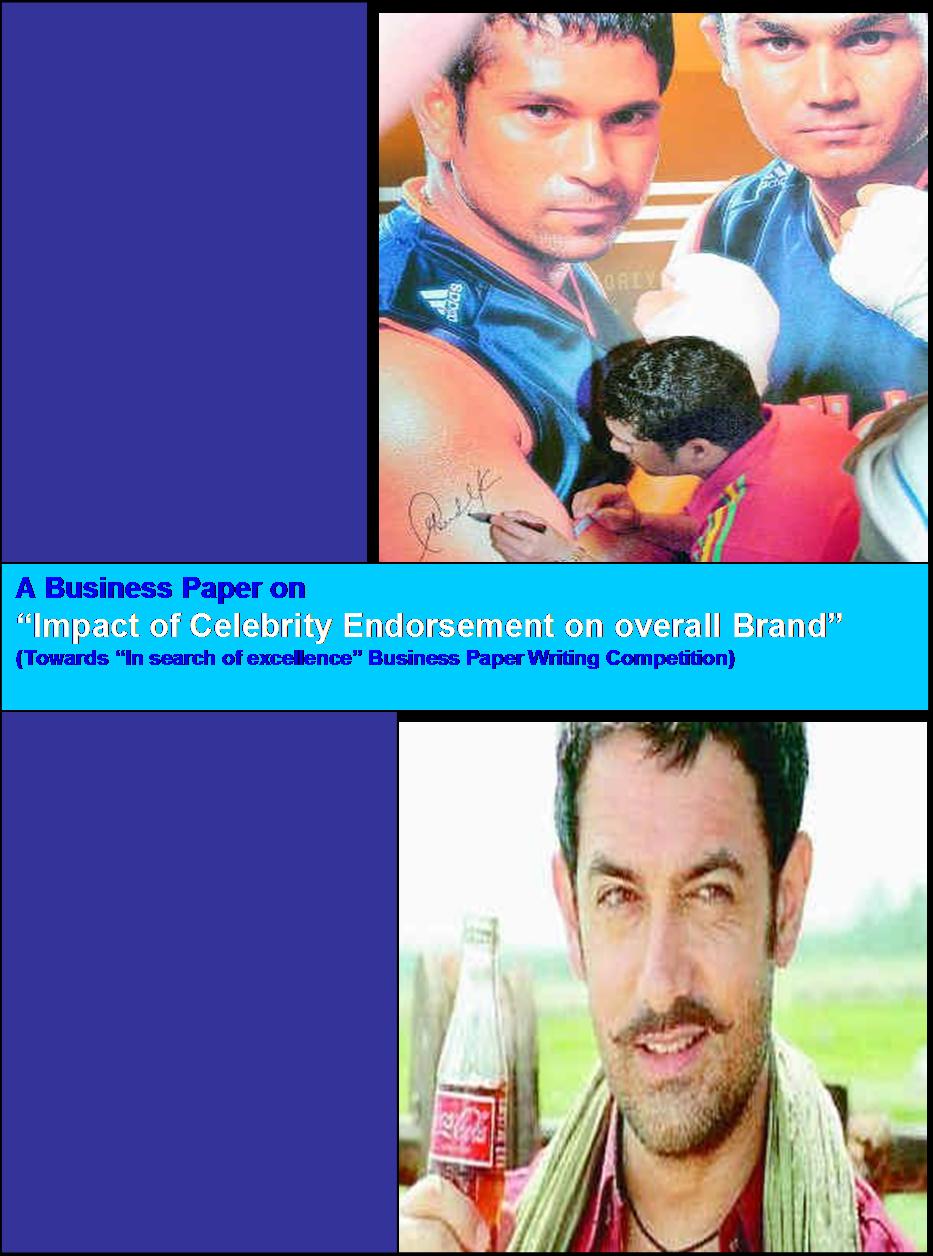
Impact of Celebrity Endorsement on overall Brand


ABSTRACT


Successful branding programs are based on the concept of singularity. The objective is to create in the mind of the prospect the perception that there is no other product on the market quite like your product
- Al Ries & Laura Ries


Indian advertising started with the hawkers who used to call out their wares right from the days when cities and markets first began. Since then, Indian advertising has metamorphosed into a strategic tool that enhances sales, siphons more profits and helps in the process of brand-building and product promotion. With this evolved a strategy that tried to benefit from the emotional attachment of the admirers or the fans of the celebrities; in the form of celebrity endorsement. It does help in creating instant awareness & visibility; but for a cost.

This paper tries to look beyond the obvious benefits that might be derived out of celebrity endorsement. It tries to understand the process of consumer psychology and impact of celebrity endorsement on the overall process of brand building. The in-depth study of various models brings to light the complexities pertaining to celebrity endorsement. Analyzing its success is as much a necessity as is the understanding of its need. The importance of celebrity management has been emphasized to realize success or failure in its true sense. A symbiotic model has been proposed to define: how to make celebrity endorsement a win-win situation for both the brand and the brand-endorser.

“Brand” is the most valuable asset of any firm. Any thoughtless adventure can be like the Sword of Damocles. It’s the “strong idea” of promotion which is a more strategic means of brand-building; which can be an economical alternative over celebrity endorsement.


It doesn't matter how new an idea is: what matters is how new it becomes.- Elias Canetti


--------------------------------------------------------------------------

Impact of Celebrity Endorsement on overall Brand

--------------------------------------------------------------------------

“If you're trying to persuade people to do something, or buy something, it seems to me you should use their language, the language in which they think."
-David Ogilvy


1. INTRODUCTION

If the world were full of all wise men and all wise women; we would have never heard of a term called “advertisement”. And then good products would have found the right customers and grown to prosperity. Firms would have worked out a mathematical formula to sell and succeed. But the buying process isn’t rational; and so is this world.

Today, the business firms are trying out different ways in advertisement to increase their sales. Indians are die-hard movie and sport buffs; and this aspect of the consumers has invited the concept of “Celebrity Endorsement” to the world of advertisement. The purpose of this paper is to analyze the role of Celebrity Endorsement in the process of brand-building by taking appropriate examples from the advertising landscape.

2. BRANDING & CELEBRITY ENDORSEMENT

Indian Firms have been juxtaposing their brands with celebrity endorsers in the hope that celebrities may boost effectiveness of their marketing and/or corporate communication attempts. Today, use of celebrities as part of marketing communication strategy is fairly common practice for major firms in supporting corporate or brand imagery.

2.1 What is a Brand?
Jack Welch, the former CEO of General Electric once said “Our most valuable assets are our intangible assets.” The intangible asset he was referring to is a brand. The Dictionary of Business & Management defines a brand as: a name, term, sign, symbol, or design, or a combination of them, intended to identify goods or services of one seller or a group of sellers and to differentiate them from those of competitor.

2.2 Definition of Celebrity
A celebrity is a person who is widely recognized in a society. Whereas attributes like attractiveness, extraordinary lifestyle or special skills are just examples and specific common characteristics cannot be observed. It can be said that within a corresponding social group celebrities generally differ from the social norm and enjoy a high degree of public awareness. Today’s celebrities are larger figures from movies (Amitabh Bachchan, Shah Rukh Khan), television (Larry King, Smriti Irani) and sports (Sachin Tendulkar, Michael Schumacher).

2.3 Definition of Celebrity Endorsement
According to Friedman & Friedman a “celebrity endorser is an individual who is known by the public for his or her achievements in areas other than that of the product class endorsed.” So, in the Coco-Cola advertisement; actor Amir Khan is the celebrity endorser for the product or brand called Coke and this process is referred to as Celebrity Endorsement.

3. THE NEED FOR CELEBRITY ENDORSEMENT

The charisma of the celebrities almost always entices people and their words are worshipped by a lot of people. Their influence also goes on the political front, where they are invited for political endorsement. The business firms thus resort to celebrity endorsement to perk up brand recall and product sales. This has now become a trend and is being perceived as a strategic means of brand building exercise. The Elaboration Likelihood Model (EML) suggests that consumers will scrutinize claims more in important situations (say life saving drugs) than in unimportant ones. So, for almost similar products like Coke & Pepsi it makes sense to use endorsement. Also, Friedman & Friedman have shown that a celebrity relative to a non-celebrity spokesperson would be more effective for products high in psychological or social risk, involving such elements as good taste, self-image, and opinion of others. Just for example when actor Shah Rukh Khan endorses Santro-Zip drive; the consumers are made to think that he is giving his opinion to go for this car.

Two reasons why advertisers need celebrity endorsement are to increase the credibility & attractiveness of their advertisement. This is solely to affect consumers’ attitude towards their brand. To justify this hypothesis, we can take the example of former Miss Universe Sushmita Sen who helped the Epson brand of printers achieve instant recognition; even with the established giants like Hewlett-Packard and Wipro in the running. Similarly, actress Rani Mukherjee has turned the tables for Bata’s ladies footwear brand called Sundrop as sales increased by a whooping 500%.

4. THE PROCESS OF CELEBRITY ENDORSEMENT

The process of celebrity endorsement is more of meaning translation & meaning application. A deeper insight into this complex process is provided by the following theory.

4.1 The Meaning Transfer Model
McCracken, the author to this model, has suggested that “The effectiveness of the endorser depends, in part, upon the meaning he or she brings to the endorsement process.” A celebrities’ effectiveness as endorsers stems from the cultural meanings with which they are endowed. It is a three-stage process of meaning transfer that involves the formation of celebrity image, transfer of meaning from celebrity to the brand, and finally from the brand to the consumer.

Figure 1: The Meaning Transfer Model


To explain it with the help of an example, we can take the case of Rahul Dravid and Castrol. The cricket icon is seen as “Mr. Dependable”. And when he endorses Castrol, an image of “dependability” is tagged on to the brand under promotion.

5. THE IMPORTANCE OF CELEBRITY MANAGEMENT

In a world full of faces, the ones’ which bolt from the blue are perhaps of the celebrities. The advertisers are always on the look out for such faces for the purpose of endorsement. But, the major challenge before them is to find the right faces for their brands or in other words celebrity management. McCraken quotes: “In the best of all possible worlds, the marketing or advertising firm first would determine the symbolic properties sought for the product... It would then consult a roster of celebrities and the meanings they made available, and taking into account budget and availability constraints, would choose the celebrity who best represents, the appropriate symbolic properties.” This suggests that the image of the celebrity must fit or be congruent with the product which can be explained from the theoretical perspective using a social cognition framework.


5.1 Schema-Based Expectancy Theory
A schema is an abstract, cognitive structure that represents some stimulus domain, e.g., a person, place, event, or thing. It is organized through experience and consists of a knowledge structure. They can determine what information will be encoded or retrieved from memory. Schemas are involved in encoding, interpretation, retention, and retrieval of information. They can influence perceptual cognitive activities through the generation of expectancies. In the case of well-known celebrities, individual would typically have personal relevant schemas (person schemas), acquired over time. When a celebrity endorses a brand, the characteristics of that celebrity may be compared with the advertised attributes of the brand by the audience for congruence or fit with their available person-schema. The degree of congruence between the new information (the brand attributes) and the existing information (the celebrity's characteristics) may then influence the level of recall of the new information.

The Associative Network Model suggests that information inconsistent with an individual's schema may be quite salient and information will, therefore, be attended to more closely and be processed more deeply. Therefore, this information would be conceptually linked to a larger number of items in the memory, compared to a piece of information that is consistent with the schema.

While the Schema-Pointer + Tag Model proposes that consistent or typical items are encoded in terms of a "pointer" to a generic schema that contains the typical components and relationships for that particular knowledge domain. The atypical or incongruent items are, on the other hand, encoded with a rather distinctive "tag" and stored as a unique, separate unit. This leads to higher recalling for incongruent items than for typical items. And empirical researches confirm significantly higher recalling when the image of the celebrity is congruent with the brand image. Therefore, celebrity management it is very important for the success of any brand.


"If commerce is the engine of our economy, then advertising is the spark. Responsible advertisers are the drivers who keep us on the right track, leading to a richer, more benevolent society."
-Brian Philcox


6. CELEBRITY SELECTION

There are various scientific ways in which the right celebrity is selected for the product endorsement, which are discussed hereunder.

6.1 Stereotyping
Tellis defines stereotypes as perceptions and depictions of individuals based on simplistic, biased image of the group to which they belong, rather than on their own individual characteristics. For example: its’ better to select celebrities who say are teens for chocolate advertisements and females for detergent ads etc.

6.2 The TEARS Model
The attributes highlighted by the acronym “TEARS” are gauged for celebrity selection. These are:
Trustworthiness: For example – Legendary actor Amitabh Bachchan who is an icon of trust; promoting ICICI Bank.
Expertise: For example – Golfer Tiger Woods for a sports brand.
Attractiveness: For example – Tennis player Anna Kournikova who earns 10 Million dollars per year in just endorsement.
Respect: For example – Former Miss World Aishawarya Rai and the Eye donation campaign.
Similarity: For example – a child artist promoting a
- celebrity credibility, chocolate brand.
A celebrity scoring high on all the above attributes can turn out to be a good endorser for the brand under question.

6.3 The no TEARS Model
The “no TEARS” approach is a tool for managers and their advertisers how to go about selecting celebrities so as to avoid the pitfalls from making an unwise decision. It gauges the following information:
- celebrity & audience match up,
- celebrity and brand match up,

- celebrity attractiveness,
- cost consideration,
- a working ease and difficulty factor,
- an endorsement saturation factor,
- a likelihood-of-getting-into-trouble factor

Selecting the right celebrity does more than increasing sales; it can create linkages with the celebrities’ appeal, thereby adding new dimension to the brand image. Research conducted by Katherine Eckel has revealed celebrities can get people to make a better choice but cannot influence ‘people to make a foolish choice’. The success of celebrity endorsement in India can be sought from a market research conducted earlier which found that 8 out of 10 TV commercials scored the highest recall were those with celebrity appearances. A few examples: Sachin Tendulkar-Adidas, Sourav Ganguly-Britannia, Leander Paes and Mahesh Bhupati-J. Hampstead, Shah Rukh Khan-Pepsi, Sushmita Sen-Epson and Aishwarya Rai-Coke.

7. WHY CELEBRITY ENDORSEMENT FAILS?

There maybe cases where brands are not able to take-off even after the backing of celebrities. And this leads to speculations in the Ad World on the soundness of celebrity endorsement as an effective communication strategy.

7.1 The Reasons
According to leading management thinker Dr Seamus Phan, “Many celebrity endorsements fail because they identify a celebrity they like in an emotive and un-researched manner and then try to create advertising to force-fit the celebrity into the creative concept.” Therefore, the advertisers must associate the celebrity to the advertisement and not vice versa. Thinking on the similar lines, the advertisers shouldn’t identify the brand to associate with the celebrity but do vice versa. The success of celebrity endorsement also depends upon the capacity, knowledge, experience, and qualification to talk about the product. Failure may be attributed to improper positioning (Example: Amitabh Bachchan, Abhishek Bachchan & Maruti Versa), negative perception after use of product/service (inferior products), misapprehension of the meaning of the endorsement, etc.


"The philosophy behind much advertising is based on the old observation that every man is really two men -- the man he is and the man he wants to be."
- William Feather


Another reason for the celebrity endorsement to turn against the brand is due to “Overshadowing.” This happens when the celebrity is larger than the brand being endorsed. And unfortunately though the celebrity generates higher levels of attention among viewers, the impression is not always strongly linked to the advertised brand. Finally, brand may also fail to get noticed given a recent negative publicity of the celebrity endorser. Example: Michael Jordan lost his endorsement deals when he announced in 1991 that he’s HIV-positive. It wasn’t until July 2003 that he landed his first endorsement deal since the announcement.

7.2 The Solutions
As discussed, celebrity management is very crucial to avoid the brand-celebrity disconnect and subsequently brand failures. Proper market research should be carried out and right positioning strategies should be in place. If the consumers have questions in their minds regarding the quality or performance of the product then even God cannot save the brand. There shouldn’t be any ambiguity or confusions when showing the celebrity in the advertisement. The obvious solution to the problem of overshadowing is to make sure that both the advertisement and the celebrity are focused on the brand or product. To avoid any bad publicity arising out of celebrity defames, companies may resort to multiple celebrity endorsement. For Example: Pepsi while capitalizing on the popularity of cricket and films in India used several cricketers and film stars in their ads. So when Azharuddin & Jadeja got embroiled in the match-mixing controversy, Pepsi’s severed its association only with these stars, but its relationship with cricket continued.

7.3 The Symbiotic Model
Based on our understanding of the celebrity endorsement process we can propose our own model taking cue from the biological kingdom. There are various symbiotic relationships that can exist between two organisms. Similarly, we can visualize two entities “brand” and “celebrity”. To achieve a perfect success there should be absolute symbiosis between the two entities. There may be one of the six effects to the celebrity endorsement process:

Figure 2: The Symbiotic Model


Mutualism (M): Both help each other (Example: Tata & Narayan Karitiken)
Commensalism (C1): Only one among them is benefited (Example: A failed endorsement)
Parasitism (P): One is benefited; other is harmed (Example: Azharuddin and Pepsi. Also, Home Trade & Shah Rukh Khan, Sachin Tendulkar, Hritik Roshan)
Neutralism (N): None of them benefited or harmed (Example: Amitabh Bachchan, Abhishek Bachchan and Maruti Versa)
Amensalism (A): Only one of them is harmed; other unaffected
Competition (C2): Both are harmed

Celebrity endorsement is a complex process of balancing your risk with your gains.


"The pure and simple truth is rarely pure and never simple."
-Oscar Wilde


8. CELEBRITY ENDORSEMENT: THE ISSUES INVOLVED

There are several factors to consider before resorting to celebrity endorsement. There is no single formula to win in the world of marketing. A company must analyze the prospect of endorsement from 360 degrees, prior to product promotion.

8.1 Price vs. Profit
The most important issue is that of return on investment (ROI). Companies need to perform a cost-benefit analysis prior to endorsement. The process of gauging the effectiveness of endorsement on the overall brand is but difficult. The companies expect to bring, in the long run, future sales, revenues and profit from the present investments on celebrity endorsement. Celebrity endorsement is an expensive means of brand promotion and the price burden almost always shifts on to the consumers; if not then it narrows the companies’ profit.

8.2 Multiple Brand Endorsement vs. Multiple Celebrity Endorsement
In the advertising landscape we find either a celebrity endorsing multiple brands or multiple celebrities being used to endorse a single brand. Sachin Tendulkar for example in 2002 endorsed 12 brands (including Pepsi, Boost, Colgate Total, Gillette, Britannia Tiger, Fiat Palio, TVS Victor, Fiat Sienna, MRF, Adidas, Visa Cards and Home Trade). Tripp et al, says that the endorsement of as many as four products negatively influences the celebrity spokesperson’s credibility and likeability.


Figure 3: Multiple Brand Endorsement (Shah Rukh Khan)

Also, the use of multiple celebrities to endorse a brand may hinder the meaning transfer process and thus lead to confusion among the consumers.


Figure 4: Multiple Celebrity Endorsement (Adidas & Hyundai Santro)

9. CONCLUSION

Celebrity endorsement can be a goldmine or a minefield for a company’s brand building process. There have been extensive studies relating to the process of celebrity endorsement and brand-building. These studies indicate that celebrity endorsement has worked well in some consumer segments while failing in others. Few celebrities have been more successful than those with almost parallel fame. So the role of celebrity endorsement in the advertising space is equivocal and cannot be seen as a assured strategic tool to win profits, market share, revenues, etc.

Consumers can identify the clear difference between a good script and a good brand idea. For example, while Pepsi's Sachin and Bachchan (kite flying) ad was seen as one with a good script, Coca-Cola's Thanda Matlab… was seen as an insightful and strong brand idea. For all the flak it drew in its vainglorious attempts to run down competition, Thumbs Up was seen as the only example of seamless linkage between brand positioning and brand celebrity.

“Brand” is the most valuable asset of any company; building its image is thus of paramount importance. Any thoughtless adventure can be like the Sword of Damocles upon your head. Celebrities do not make brands but ideas do. If the former were true then brands would have vanished when the hype and hoopla around the celebrities faded. Celebrity endorsement is also one of the ideas. But, its’ easy to come up with new ideas; the hard part is letting go of what worked for you two years ago, but will soon be out-of-date. Therefore, it is imperative to invest in good ideas; which will bring good returns. Thus the need of the hour is to focus less on your Return-on-Investment and think more in terms of your Return-on-Ideas.
“There is one thing which is stronger than all the armies of this world, and that is an idea whose time has come”
-Victor Hugo

Saturday, May 13, 2006

Using E-commerce to fuel rural growth in India


ABSTRACT

“There are no such things as limits to growth, because there are no limits to the human capacity for intelligence, imagination, and wonder"
-Ronald Reagan


“Incredible India” is a theme which is promoting brand “India”. And sixty percent of India comprises of rural India. Unless you are a good sales executive; it is difficult to pronounce anything incredible happening in the rural part of India.

E-commerce together with Information & Communication Technologies (ICT) holds great promise for the socio-economic development of rural hinterlands in India. The growth of Indian economy depends upon the growth of so-called population that forms the “Bottom of the Pyramid” of which Mr. CK Prahalad speaks of. It is also difficult to attain the 10% growth rate which we strive to achieve every year. The agricultural contribution towards the GDP is on a decline. This paper tries to explore how the use of e-commerce can bring about changes in the lives of the rural population and fuel economic growth & development.

The use of e-commerce by the rural poor leads to efficient price discovery and offers economy of transaction for agricultural trading. Above all it tries to acknowledge the problem of “Asymmetry of Information”. And unless this is not done away with, we cannot provide a level-playing field to the people of rural India.

By this paper, the implementation of a rural e-commerce project has been proposed by using a strategic model. And various rural e-commerce applications have been recommended together with success stories of similar projects. Presently the policy makers, administrative workers and citizens are at a loggerhead while rural businesses are still waiting to take off. To carry forward the “India shining” campaign, all we need to do is to:

“Act, act in the present. And trust no future however pleasant”
--------------------------------------------------------------------------------
Using E-commerce to fuel rural growth in India
---------------------------------------------------------------------------------

“There is one thing which is stronger than all the armies of this world, and that is an idea whose time has come”
-Victor Hugo

1. INTRODUCTION

If wishes were horses, rural India would have progressed far beyond her present state. What we see instead is that policy makers, administrative workers and citizens are at a loggerhead while rural businesses are still waiting to take off. The purpose of this paper is to define the role of E-commerce in fueling rural growth in the country. It tries to identify the contemporary needs and aspirations of rural India and proposes a model to acknowledge the same.

1.1 Why Rural India?
India with a billion plus population holds 600 million of her people in the rural areas. And a hefty 66% of the workforce is employed in agriculture; which is credited to the rural areas. It is therefore, imperative to toil hard for rural growth & development.

1.2 Why E-commerce?
E-commerce has already added many feathers to its cap, and is being viewed as a strategic tool that can fuel rural growth in various developed and developing economies of the world. India has already moved ahead to grab the opportunity and did almost Rs 450 Crores of e-commerce business in 2004. There is no wonder why the same success story cannot be repeated for India’s largest consumer segment i.e. the rural market.

2. E-COMMERCE & RURAL INDIA

E-commerce in India is in the nascent stage, but even the most pessimistic projections indicate a boom. The multifarious benefits offered by e-commerce offers thus make it the preferred choice for possible adoption in rural India.

2.1 What is E-commerce?
It literally means buying and selling of goods and services on the Internet especially using the World Wide Web (WWW). E-commerce provides multiple benefits to the consumers in the form of availability of economical goods or services, wider choices and saves time. People can buy and sell goods or services with a click of a mouse without moving out of their house or office.

2.2 Traditional Rural Setup
Urban & Rural India is categorized based on population, primary employment of males & population density. The rural business encompasses agricultural activities like cultivation, livestock, forestry, fishing, plantation, etc and other non-agricultural activities. Past economic figures suggest rural contribution of 50% (20-30% by Agricultural activities alone) of Gross Domestic Product (GDP).

The agricultural market is inefficient given the asymmetry of price information, as the prices prevailing at the mandis are often not known to them. This is because of the presence of numerous middlemen who siphon off a large part of the price and consequently pass only a small amount to the farmers. They are also duped while making purchases of agricultural resources.

Asymmetry of information is a formidable problem for the growth of rural India; be it agriculture, education or entrepreneurship development.

2.3 Introduction of E-commerce
E-commerce can promise an effective market place for the rural populace which will do away with the traditional roadblocks and asymmetry of information. E-commerce is a wider term and encompasses: e-governance, e-business & e-citizen.


Needless to mention, that to provide such an e-commerce infrastructure would be an uphill task. But, it has been aptly said:

"Growth begins when we begin to accept our own weakness"
- Jean Vanier

2.4 Benefits of E-commerce
E-commerce is a cost-effective simulation of common-place market operations. It reduces space & time boundaries. It also promotes transparency & accountability and enables swift delivery of information and services. The rural populace can reap the benefits of this medium by actualizing their long-established market operations into this.

3. FEASIBILITY STUDY

The billion dollar question is “Can the success stories of e-commerce be paralleled with rural India?” This would require a lot of introspection: research & analysis. Methodically speaking, it would be wise to first gauge the bottlenecks and then try to find solutions to them.

3.1 The Bottlenecks
There are several impediments which make this endeavor a daunting task. The formidable ones being:
3.1.1 Infrastructure
E-commerce requires the use of Internet and Communication Equipment viz. typically a Personal Computer (PC). On a broader sense, e-commerce requires the use of Telecommunication Infrastructure for connectivity and Power Infrastructure for electricity. At present the rural teledensity stands at an abysmal 1.70 (with negligible contribution coming from mobile services). While only 30.54 per cent of rural households have electricity [HDR 2002].
3.1.2 Technology
Information & Communication Technologies (ICT) has to be looked at the backdrop of e-commerce bottlenecks. Issues relating to content and connectivity have to be addressed.
3.1.3 Finance
Such a model has to be backed with promising monetary funding. It needs to be seen, as to who would be at the forefront of this.
3.1.4 Human Resources
Trainers, motivators, supporters, administrators among other people would be required for such a project to take off.
3.1.5 Diversity
It would be imprudent to consider rural India as a homogenous sector. Perhaps it is very diverse and her culture, dialect, aspirations, economics, environment, politics, etc maybe poles apart.

3.2 The Solutions
We cannot waste another generation to see this project to reality; it’s nor or never. The implementation has to be fast and should be backed by continuous feedback and assessment.
3.2.1 Infrastructure
The Ministry of Communication & Information Technology is looking forward to teledensity of 22 by 2007 (prioritizing rural India). The private companies like Reliance have promised to expand in the rural areas. Prices of PCs are coming down heavily and abridged versions are being created for the rural masses. The concept of Thin Clients and Fat Servers is just another example which can help provide low-cost computing solution. The indigenously made Simputer can also come handy. Various organizations are promoting the use of non-conventional sources of energy like solar energy, biogas, etc.
3.2.2 Technology
Wireless solutions like WiFi, WiMAX, corDECT and VSAT could be preferred over wired solutions. But what is interesting is that the Optical Fiber backbone is not being highlighted in this frame of discussion. Considering the present or proposed OFC Network of BSNL (4,00,000 km), Indian Railways (35,000 km), Power Grid (14,0000 km), GAIL (14,500 km), Reliance Infocomm (60,000 km) among others, the ball certainly seems to be in our court. Today 85% of the taluka headquarters have optic fiber, which can provide the backbone for telecom and Internet connectivity.
3.2.3 Finance
There are various government organizations that support such initiatives. Individual efforts to provide used PCs to the rural populace have also been in the light of all things; also the work done by local NGOs. But it would be the private organizations which can provide a Win-Win solution here. The Government funded projects do not stand much of a chance for successful completion. This can be explained by a simple philosophy. There are four ways in which money can be spent: Money earned by us and we spend it on ourselves; Money earned by us and we spend it on others; Money earned by someone else and we spend it on ourselves; and Money earned by someone else and we spend it on others. We tend to be less and less prudent and lackadaisical in money management as we move from category one through four. The government funding unfortunately falls in the latter category and thus prone to abuse and under-utilization.
3.2.4 Human Resources
Training can be imparted by engaging a group of teachers from the upper primary schools. Rural population has a primary school within 1 km and in 85% of the areas an upper primary school within a distance of 3 km. We have one of the largest elementary education systems in the world.
3.2.5 Diversity
The cultural diversity is a cause of concern especially the local dialect, but in majority of the areas the national languages (i.e. Hindi and English) are either spoken or understood. The intended audience should be trained on English or Hindi software applications. Software giants like Microsoft has launched a scaled-down and low-cost versions of its Windows XP Operating System (OS) and has been working on its Project Bhasha since 2003. It is also developing Microsoft Windows and Office in 14 regional languages. Similarly, Linux has also launched its Hindi version Linux v4. Usually the village panchayat plays an essential part when projects are government driven; but for Private projects the local human resources are put to use. The success of Broadband in South Korea (having highest connectivity) can be attributed to their government’s initiative to promote the use of Internet and making the use of E-learning mandatory in the schools. Once the rural populace brings the use of Internet into its culture then there would be no looking back for us. The government should promote the National languages at any cost, and may even go a step ahead in making it compulsory throughout India. Needless to mention, the popularity of any languages cannot increase unless there is some commercial aspect to it, English being the befitting example.

4. THE MODEL

Only a strategic model can turn the E-commerce project into a reality. This model would cater to short-term as well as long-term objectives; would be reviewed periodically and subjected to dynamic alterations and/or adaptations. It is here that the “5-Star Model” can be proposed:

The following steps would drive the 5-Star Model:

Step I: Strategize & Setup
Extensive research has to be carried out for selecting the appropriate locations or villages. The various parameters that have to be gauged are: Infrastructure (Electricity, Telecommunications, and Education), Population, Road & Transport, Postal & Courier Services, Primary Employment Activities, Geographical Advantages, Climate, etc.

After the research, the primary or secondary data would be analyzed to identify threshold values for the selected parameters. The villages can be segmented based on several criterion, for example villages near Mahabaleshwar can be classified as Strawberry producing zone; whereas those in and around Nagpur may be classified as Orange producing zone.

These villages would be called as “Hot-Spot” zones, because most of the experiments would be carried out only in this region. The potential customers would also be studied for example: cultivators, distributors, transporters, stock-keepers, agro-based companies, etc.

Once the areas are selected, a proposal would be drafted for setting up the required infrastructure: PCs, Internet, Hot-Spot Kiosks, etc.

Step II: Simplify
Next step would be the process of simplification of the use of e-commerce. It is here that the OS like Linux v4 or Windows XP would come handy. Every Process or FAQs would be well-documented in the local language, for example: “What has to be done when the PC or the Internet connection requires maintenance?” Even trivial things can hinder the smooth flow of any project. Till this step there wouldn’t be any interaction with the target segment i.e. the people who would actually be using the services offered by e-commerce.

Step III: Simulate
The process of selling and buying would be explained to the villagers. They would undergo short trainings for the same; also the concept of electronic money & online bank accounts would be introduced to them in due course of time. A real world simulation of the e-commerce webpage would be provided. The villagers would be given some amount of money (in their online bank account) and they have to trade their produce over the e-commerce portal and simultaneously purchase goods (like fertilizers, seeds, etc) or services. Every villager would we allowed to play the simulation over the weekends, and winners would be given some token gifts. The idea is to make them understand the concept of online transaction, of economics (sell for more & buy for less) and of online banking. This being carried out in a playful mood. And, there is also some reward for performance at the end of the day. Rest would be done by word-of-mouth advertisement which spreads like wild fire in any rural area.

Stem IV: Showcase
The villagers would gradually be introduced to the real world e-commerce portals; where they would be offering their products or services as also request for the same. It should always be remembered that if villagers are not able to make profit out of the e-commerce project; then that would be the end of the story. We expect that the villagers would learn with their experiences and make good money out of it. It would be then that the success stories need to be showcased in upcoming hot-spots or potential areas that can be turned into a hot-spot.


“People need support and motivation to understand why it is worth their time and money to acquire these new tools and learn how to use them”
-Alex ‘Sandy’ Pentland

Step V: Spread
Once the process takes off then the frequency of the hot-spots can be increased in the adjoining or new areas. This would help spread the 5-Star Model thus providing greater reach of e-commerce as also the extent of rural growth.

5. VARIOUS E-COMMERCE APPLICATIONS

All customers identified during the research phase would be motivated to use the common e-commerce portal. Initially it would be very elementary & easy to use. Later on advancements and modifications can be introduced into the portal. A lot of creativity & innovation can go into the e-commerce portals and nominal charges can be levied on the customers. But the benefit that can be derived out of the mass utilization of e-commerce would be immense considering the second most populous country in the world. Some of the rural applications may include:
Job openings
This can help solve the unemployment problem in the rural areas.
Matrimonial
This can help in the selection of suitable bride or bridegroom.
Land Record Maintenance
This can help in ending disputes over ownership (which is very common) by means of digitization of records.
Agricultural & Technology
New agricultural equipments/hybrid seeds or any other technological advancement can be introduced to the rural farmers.
Rural Telephony
Economical voice services (using Internet Telephony) can be provided to the villagers who want to communicate to their friends or relatives outside India (still illegal inside India).
Travel
Information on travels and tours. As also, online booking or reservations.
TeleMedicine or TeleDoctor
Medical consultations can be sought by means of emails or video conferencing via economical webcams.
Agriculture Consultancy
Online consultancy can be sought regarding farm productivity, soil requirements, nourishments, plant diseases & remedies.
Talent Search Contest
Participation in various talent search events by means of online registration.
Online Banking
This would come much to the respite of insurance and others companies involving bill receipt and payments like electricity, telephone, etc.
Rural E-lance
The rural populace can outsource their products or services to any 3rd party and vice versa. Example: Producing potatoes for use in French Fries by MNC or big retail food outlets like Pizzahut or Nirulas.
Auctioning
Rural products can also be auctioned over the Internet, for example: used farm equipments, etc.
Courier Service
Local courier service would grow with the growth of e-commerce transactions.
Market Research
A population of 600 million is a potential market especially for FMCG companies like HLL. To understand the diverse moods and aspirations of this market, paid market researches can be conducted.

In fact, there may be numerous applications that can get a berth in the rural e-commerce portal.
6. SUCCESS STORIES

There are several projects that have been introduced with the prime objective of fueling rural growth. Its’ not important to know if they succeeded or failed, what’s important is to know why they succeeded or failed? Here are a few to quote:
Bhoomi
Bhoomi is a self-sustainable e-governance project for computerizing land records and making them available to the people of Karnataka for a nominal fee.
TaraHaat
It is an e-marketing portal for the rural populace.
Gyandoot
The goal of the project is to establish community-owned, technologically innovative and sustainable information kiosks in the rural areas of Madhya Pradesh.
eSeva
It has been initiated by the Andhra Pradesh government to provide “one-stop non-stop Government-to-Citizen (G2C) services”.
Information Village
It is a MS Swaminathan Research Foundations’ experiment to electronically deliver knowledge to the rural masses in Pondicherry.
Drishtee
It is an organizational platform for developing IT enabled services to rural and semi-urban populations through the usage of state-of-the-art software.
ITC’s eChoupals
eChoupals have been set across the agricultural belt to offer the farmers all the information, products and services they need to enhance farm productivity, improve farm-gate price realization and cut transaction costs. All these information are received through their Hindi portal.
Akashganga
Based in Gujrat, it has been conceived with the objective to spread IT among dairy cooperatives.
Setu
It is an initiative by the Maharashtra Government to create a foundation for citizen centric e-governance at district as well as taluka headquarters.
Shristi
It is a NGO setup to strengthen the creativity of grassroots inventors, innovators and ecopreneurs engaged in conserving biodiversity and developing eco-friendly solutions to local problems.
Other Technology-related initiatives
Media Lab Asia (MIT Media Lab & Indian Govt.), Warana Wired Village (Sugarcane Cooperatives, Maharashtra), SARI (Tamil Nadu), FRIENDS and Akshaya (Kerela), Mahiti Shakti Kendras (Gujrat)
Other Educational IT initiatives
Headstart (Madhya Pradesh), AP Schools (Andhra Pradesh & NIIT), Vidya Vahini, Community Learning Centers (Azim Premji Foundation)

7. CONCLUSION

E-commerce can fuel rural growth. But, for it to succeed, we have to first step into the shoes of the rural populace and strategize from all angles. To put it straight, if they are not able to make money out of it, then the project is doomed to fail. Administrative reorganizations occur in the political tenures, red-tapism still persists and government processes aren’t time-efficient. Thus the initiative should come from the private players; it is they who can provide a Win-Win model. And there should be continuous monitoring and assessment to make it succeed.

“The line between failure and success is so fine that we scarcely know when we pass it; so fine that we are often on the line and do not know it”
-Elbert Hubbard