ABSTRACTSuccessful branding programs are based on the concept of singularity. The objective is to create in the mind of the prospect the perception that there is no other product on the market quite like your product
- Al Ries & Laura Ries
Indian advertising started with the hawkers who used to call out their wares right from the days when cities and markets first began. Since then, Indian advertising has metamorphosed into a strategic tool that enhances sales, siphons more profits and helps in the process of brand-building and product promotion. With this evolved a strategy that tried to benefit from the emotional attachment of the admirers or the fans of the celebrities; in the form of celebrity endorsement. It does help in creating instant awareness & visibility; but for a cost.
This paper tries to look beyond the obvious benefits that might be derived out of celebrity endorsement. It tries to understand the process of consumer psychology and impact of celebrity endorsement on the overall process of brand building. The in-depth study of various models brings to light the complexities pertaining to celebrity endorsement. Analyzing its success is as much a necessity as is the understanding of its need. The importance of celebrity management has been emphasized to realize success or failure in its true sense. A symbiotic model has been proposed to define: how to make celebrity endorsement a win-win situation for both the brand and the brand-endorser.
“Brand” is the most valuable asset of any firm. Any thoughtless adventure can be like the Sword of Damocles. It’s the “strong idea” of promotion which is a more strategic means of brand-building; which can be an economical alternative over celebrity endorsement.
It doesn't matter how new an idea is: what matters is how new it becomes.- Elias Canetti
--------------------------------------------------------------------------
Impact of Celebrity Endorsement on overall Brand
--------------------------------------------------------------------------
“If you're trying to persuade people to do something, or buy something, it seems to me you should use their language, the language in which they think."
-David Ogilvy
1. INTRODUCTION
If the world were full of all wise men and all wise women; we would have never heard of a term called “advertisement”. And then good products would have found the right customers and grown to prosperity. Firms would have worked out a mathematical formula to sell and succeed. But the buying process isn’t rational; and so is this world.
Today, the business firms are trying out different ways in advertisement to increase their sales. Indians are die-hard movie and sport buffs; and this aspect of the consumers has invited the concept of “Celebrity Endorsement” to the world of advertisement. The purpose of this paper is to analyze the role of Celebrity Endorsement in the process of brand-building by taking appropriate examples from the advertising landscape.
2. BRANDING & CELEBRITY ENDORSEMENT
Indian Firms have been juxtaposing their brands with celebrity endorsers in the hope that celebrities may boost effectiveness of their marketing and/or corporate communication attempts. Today, use of celebrities as part of marketing communication strategy is fairly common practice for major firms in supporting corporate or brand imagery.
2.1 What is a Brand?
Jack Welch, the former CEO of General Electric once said “Our most valuable assets are our intangible assets.” The intangible asset he was referring to is a brand. The Dictionary of Business & Management defines a brand as: a name, term, sign, symbol, or design, or a combination of them, intended to identify goods or services of one seller or a group of sellers and to differentiate them from those of competitor.
2.2 Definition of Celebrity
A celebrity is a person who is widely recognized in a society. Whereas attributes like attractiveness, extraordinary lifestyle or special skills are just examples and specific common characteristics cannot be observed. It can be said that within a corresponding social group celebrities generally differ from the social norm and enjoy a high degree of public awareness. Today’s celebrities are larger figures from movies (Amitabh Bachchan, Shah Rukh Khan), television (Larry King, Smriti Irani) and sports (Sachin Tendulkar, Michael Schumacher).
2.3 Definition of Celebrity Endorsement
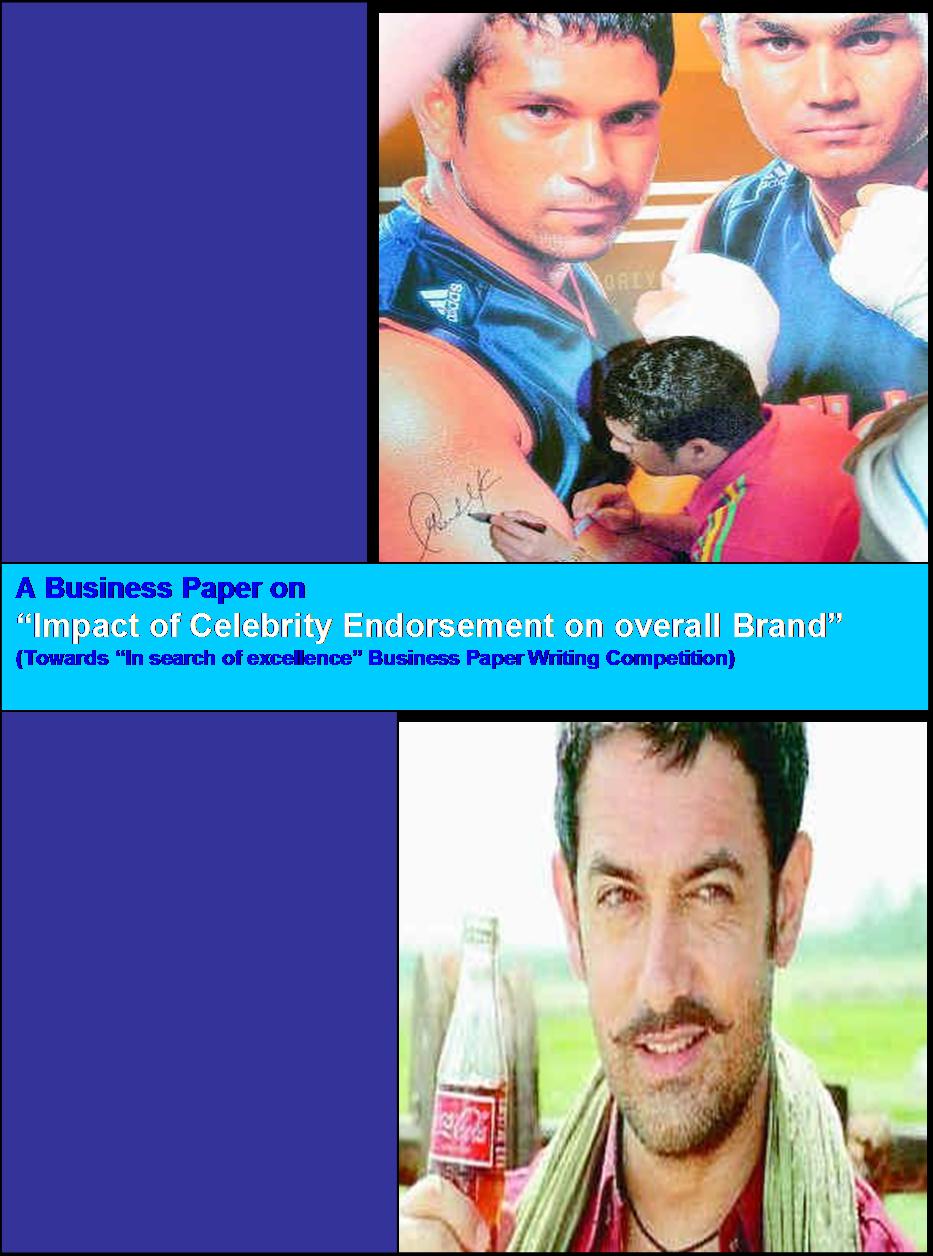
According to Friedman & Friedman a “celebrity endorser is an individual who is known by the public for his or her achievements in areas other than that of the product class endorsed.” So, in the Coco-Cola advertisement; actor Amir Khan is the celebrity endorser for the product or brand called Coke and this process is referred to as Celebrity Endorsement.
3. THE NEED FOR CELEBRITY ENDORSEMENT
The charisma of the celebrities almost always entices people and their words are worshipped by a lot of people. Their influence also goes on the political front, where they are invited for political endorsement. The business firms thus resort to celebrity endorsement to perk up brand recall and product sales. This has now become a trend and is being perceived as a strategic means of brand building exercise. The Elaboration Likelihood Model (EML) suggests that consumers will scrutinize claims more in important situations (say life saving drugs) than in unimportant ones. So, for almost similar products like Coke & Pepsi it makes sense to use endorsement. Also, Friedman & Friedman have shown that a celebrity relative to a non-celebrity spokesperson would be more effective for products high in psychological or social risk, involving such elements as good taste, self-image, and opinion of others. Just for example when actor Shah Rukh Khan endorses Santro-Zip drive; the consumers are made to think that he is giving his opinion to go for this car.
Two reasons why advertisers need celebrity endorsement are to increase the credibility & attractiveness of their advertisement. This is solely to affect consumers’ attitude towards their brand. To justify this hypothesis, we can take the example of former Miss Universe Sushmita Sen who helped the Epson brand of printers achieve instant recognition; even with the established giants like Hewlett-Packard and Wipro in the running. Similarly, actress Rani Mukherjee has turned the tables for Bata’s ladies footwear brand called Sundrop as sales increased by a whooping 500%.
4. THE PROCESS OF CELEBRITY ENDORSEMENT
The process of celebrity endorsement is more of meaning translation & meaning application. A deeper insight into this complex process is provided by the following theory.
4.1 The Meaning Transfer Model
McCracken, the author to this model, has suggested that “The effectiveness of the endorser depends, in part, upon the meaning he or she brings to the endorsement process.” A celebrities’ effectiveness as endorsers stems from the cultural meanings with which they are endowed. It is a three-stage process of meaning transfer that involves the formation of celebrity image, transfer of meaning from celebrity to the brand, and finally from the brand to the consumer.

Figure 1: The Meaning Transfer Model To explain it with the help of an example, we can take the case of Rahul Dravid and Castrol. The cricket icon is seen as “Mr. Dependable”. And when he endorses Castrol, an image of “dependability” is tagged on to the brand under promotion.
5. THE IMPORTANCE OF CELEBRITY MANAGEMENT
In a world full of faces, the ones’ which bolt from the blue are perhaps of the celebrities. The advertisers are always on the look out for such faces for the purpose of endorsement. But, the major challenge before them is to find the right faces for their brands or in other words celebrity management. McCraken quotes: “In the best of all possible worlds, the marketing or advertising firm first would determine the symbolic properties sought for the product... It would then consult a roster of celebrities and the meanings they made available, and taking into account budget and availability constraints, would choose the celebrity who best represents, the appropriate symbolic properties.” This suggests that the image of the celebrity must fit or be congruent with the product which can be explained from the theoretical perspective using a social cognition framework.
5.1 Schema-Based Expectancy Theory
A schema is an abstract, cognitive structure that represents some stimulus domain, e.g., a person, place, event, or thing. It is organized through experience and consists of a knowledge structure. They can determine what information will be encoded or retrieved from memory. Schemas are involved in encoding, interpretation, retention, and retrieval of information. They can influence perceptual cognitive activities through the generation of expectancies. In the case of well-known celebrities, individual would typically have personal relevant schemas (person schemas), acquired over time. When a celebrity endorses a brand, the characteristics of that celebrity may be compared with the advertised attributes of the brand by the audience for congruence or fit with their available person-schema. The degree of congruence between the new information (the brand attributes) and the existing information (the celebrity's characteristics) may then influence the level of recall of the new information.
The Associative Network Model suggests that information inconsistent with an individual's schema may be quite salient and information will, therefore, be attended to more closely and be processed more deeply. Therefore, this information would be conceptually linked to a larger number of items in the memory, compared to a piece of information that is consistent with the schema.
While the Schema-Pointer + Tag Model proposes that consistent or typical items are encoded in terms of a "pointer" to a generic schema that contains the typical components and relationships for that particular knowledge domain. The atypical or incongruent items are, on the other hand, encoded with a rather distinctive "tag" and stored as a unique, separate unit. This leads to higher recalling for incongruent items than for typical items. And empirical researches confirm significantly higher recalling when the image of the celebrity is congruent with the brand image. Therefore, celebrity management it is very important for the success of any brand.
"If commerce is the engine of our economy, then advertising is the spark. Responsible advertisers are the drivers who keep us on the right track, leading to a richer, more benevolent society."
-Brian Philcox
6. CELEBRITY SELECTION
There are various scientific ways in which the right celebrity is selected for the product endorsement, which are discussed hereunder.
6.1 Stereotyping
Tellis defines stereotypes as perceptions and depictions of individuals based on simplistic, biased image of the group to which they belong, rather than on their own individual characteristics. For example: its’ better to select celebrities who say are teens for chocolate advertisements and females for detergent ads etc.
6.2 The TEARS Model
The attributes highlighted by the acronym “TEARS” are gauged for celebrity selection. These are:
Trustworthiness: For example – Legendary actor Amitabh Bachchan who is an icon of trust; promoting ICICI Bank.
Expertise: For example – Golfer Tiger Woods for a sports brand.
Attractiveness: For example – Tennis player Anna Kournikova who earns 10 Million dollars per year in just endorsement.
Respect: For example – Former Miss World Aishawarya Rai and the Eye donation campaign.
Similarity: For example – a child artist promoting a - celebrity credibility, chocolate brand.
A celebrity scoring high on all the above attributes can turn out to be a good endorser for the brand under question.
6.3 The no TEARS Model
The “no TEARS” approach is a tool for managers and their advertisers how to go about selecting celebrities so as to avoid the pitfalls from making an unwise decision. It gauges the following information:
- celebrity & audience match up,
- celebrity and brand match up,
- celebrity attractiveness,
- cost consideration,
- a working ease and difficulty factor,
- an endorsement saturation factor,
- a likelihood-of-getting-into-trouble factor
Selecting the right celebrity does more than increasing sales; it can create linkages with the celebrities’ appeal, thereby adding new dimension to the brand image. Research conducted by Katherine Eckel has revealed celebrities can get people to make a better choice but cannot influence ‘people to make a foolish choice’. The success of celebrity endorsement in India can be sought from a market research conducted earlier which found that 8 out of 10 TV commercials scored the highest recall were those with celebrity appearances. A few examples: Sachin Tendulkar-Adidas, Sourav Ganguly-Britannia, Leander Paes and Mahesh Bhupati-J. Hampstead, Shah Rukh Khan-Pepsi, Sushmita Sen-Epson and Aishwarya Rai-Coke.
7. WHY CELEBRITY ENDORSEMENT FAILS?
There maybe cases where brands are not able to take-off even after the backing of celebrities. And this leads to speculations in the Ad World on the soundness of celebrity endorsement as an effective communication strategy.
7.1 The Reasons
According to leading management thinker Dr Seamus Phan, “Many celebrity endorsements fail because they identify a celebrity they like in an emotive and un-researched manner and then try to create advertising to force-fit the celebrity into the creative concept.” Therefore, the advertisers must associate the celebrity to the advertisement and not vice versa. Thinking on the similar lines, the advertisers shouldn’t identify the brand to associate with the celebrity but do vice versa. The success of celebrity endorsement also depends upon the capacity, knowledge, experience, and qualification to talk about the product. Failure may be attributed to improper positioning (Example: Amitabh Bachchan, Abhishek Bachchan & Maruti Versa), negative perception after use of product/service (inferior products), misapprehension of the meaning of the endorsement, etc.
"The philosophy behind much advertising is based on the old observation that every man is really two men -- the man he is and the man he wants to be."
- William Feather
Another reason for the celebrity endorsement to turn against the brand is due to “Overshadowing.” This happens when the celebrity is larger than the brand being endorsed. And unfortunately though the celebrity generates higher levels of attention among viewers, the impression is not always strongly linked to the advertised brand. Finally, brand may also fail to get noticed given a recent negative publicity of the celebrity endorser. Example: Michael Jordan lost his endorsement deals when he announced in 1991 that he’s HIV-positive. It wasn’t until July 2003 that he landed his first endorsement deal since the announcement.
7.2 The Solutions
As discussed, celebrity management is very crucial to avoid the brand-celebrity disconnect and subsequently brand failures. Proper market research should be carried out and right positioning strategies should be in place. If the consumers have questions in their minds regarding the quality or performance of the product then even God cannot save the brand. There shouldn’t be any ambiguity or confusions when showing the celebrity in the advertisement. The obvious solution to the problem of overshadowing is to make sure that both the advertisement and the celebrity are focused on the brand or product. To avoid any bad publicity arising out of celebrity defames, companies may resort to multiple celebrity endorsement. For Example: Pepsi while capitalizing on the popularity of cricket and films in India used several cricketers and film stars in their ads. So when Azharuddin & Jadeja got embroiled in the match-mixing controversy, Pepsi’s severed its association only with these stars, but its relationship with cricket continued.
7.3 The Symbiotic Model
Based on our understanding of the celebrity endorsement process we can propose our own model taking cue from the biological kingdom. There are various symbiotic relationships that can exist between two organisms. Similarly, we can visualize two entities “brand” and “celebrity”. To achieve a perfect success there should be absolute symbiosis between the two entities. There may be one of the six effects to the celebrity endorsement process:
 Figure 2: The Symbiotic Model
Mutualism (M): Both help each other (Example: Tata & Narayan Karitiken)
Commensalism (C1): Only one among them is benefited (Example: A failed endorsement)
Parasitism (P): One is benefited; other is harmed (Example: Azharuddin and Pepsi. Also, Home Trade & Shah Rukh Khan, Sachin Tendulkar, Hritik Roshan)
Neutralism (N): None of them benefited or harmed (Example: Amitabh Bachchan, Abhishek Bachchan and Maruti Versa)
Amensalism (A): Only one of them is harmed; other unaffected
Competition (C2): Both are harmed
Celebrity endorsement is a complex process of balancing your risk with your gains.
"The pure and simple truth is rarely pure and never simple."
-Oscar Wilde
8. CELEBRITY ENDORSEMENT: THE ISSUES INVOLVED
There are several factors to consider before resorting to celebrity endorsement. There is no single formula to win in the world of marketing. A company must analyze the prospect of endorsement from 360 degrees, prior to product promotion.
8.1 Price vs. Profit
The most important issue is that of return on investment (ROI). Companies need to perform a cost-benefit analysis prior to endorsement. The process of gauging the effectiveness of endorsement on the overall brand is but difficult. The companies expect to bring, in the long run, future sales, revenues and profit from the present investments on celebrity endorsement. Celebrity endorsement is an expensive means of brand promotion and the price burden almost always shifts on to the consumers; if not then it narrows the companies’ profit.
8.2 Multiple Brand Endorsement vs. Multiple Celebrity Endorsement
In the advertising landscape we find either a celebrity endorsing multiple brands or multiple celebrities being used to endorse a single brand. Sachin Tendulkar for example in 2002 endorsed 12 brands (including Pepsi, Boost, Colgate Total, Gillette, Britannia Tiger, Fiat Palio, TVS Victor, Fiat Sienna, MRF, Adidas, Visa Cards and Home Trade). Tripp et al, says that the endorsement of as many as four products negatively influences the celebrity spokesperson’s credibility and likeability.


Figure 3: Multiple Brand Endorsement (Shah Rukh Khan)
Also, the use of multiple celebrities to endorse a brand may hinder the meaning transfer process and thus lead to confusion among the consumers.

 Figure 4: Multiple Celebrity Endorsement (Adidas & Hyundai Santro)
9. CONCLUSION
Celebrity endorsement can be a goldmine or a minefield for a company’s brand building process. There have been extensive studies relating to the process of celebrity endorsement and brand-building. These studies indicate that celebrity endorsement has worked well in some consumer segments while failing in others. Few celebrities have been more successful than those with almost parallel fame. So the role of celebrity endorsement in the advertising space is equivocal and cannot be seen as a assured strategic tool to win profits, market share, revenues, etc.
Consumers can identify the clear difference between a good script and a good brand idea. For example, while Pepsi's Sachin and Bachchan (kite flying) ad was seen as one with a good script, Coca-Cola's Thanda Matlab… was seen as an insightful and strong brand idea. For all the flak it drew in its vainglorious attempts to run down competition, Thumbs Up was seen as the only example of seamless linkage between brand positioning and brand celebrity.
“Brand” is the most valuable asset of any company; building its image is thus of paramount importance. Any thoughtless adventure can be like the Sword of Damocles upon your head. Celebrities do not make brands but ideas do. If the former were true then brands would have vanished when the hype and hoopla around the celebrities faded. Celebrity endorsement is also one of the ideas. But, its’ easy to come up with new ideas; the hard part is letting go of what worked for you two years ago, but will soon be out-of-date. Therefore, it is imperative to invest in good ideas; which will bring good returns. Thus the need of the hour is to focus less on your Return-on-Investment and think more in terms of your Return-on-Ideas.
“There is one thing which is stronger than all the armies of this world, and that is an idea whose time has come”
-Victor Hugo


 Imagine you are at the crossing right in-front of the Inorbit Mall in Malad, Mumbai. In all possibility you might be going over to the Mall. And then someone comes with a booklet, and gives you details of the active discount sales in the mall; and to your surprise that “someone” disappears without asking for a fee. That “someone” is suddenly transformed from a “nagging” guy to a more patient “individual”.
 Imagine you are stranded at a Karol Baug signal. You huff and puff in the dust and heat of Delhi summers. How much would a small chilled mineral water bottle (like the one’s you get in the flights) mean to you then? Priceless right? You would be ready to buy it for Rs. 10 even if it were printed Rs. 5 only. But, in the process you would stop one individual from begging on the streets.
 I see it as a big change in the making. Over the months I have collected so much from these street vendors that it seems plentiful: an aeroplane model, two cruiser bike models, a bag full of cars, a helicopter that can fly, a bird that has foldable wings which can flap. And, I don’t restrict myself only to the traffic signals, Indian railways is another haven of beggars and also these street vendors.


 And like in the movie…”Jab We Met” (of course the inspiration to my title), I prayed “Babaji…ab is journey ko boring bana do….please no more surprises”. I was asked to meet the conductor who asked me to write a letter quoting the incident so as to save the poor attendant; which I did earnestly. Seeing my gesture, the attendant (who earlier was hyper about the entire incident, thinking that he had to pay a price for it) invited me to sit on his seat. He also, confessed that it were their mistake to have kept the fire extinguisher down and also that the security cap was missing. And, like some Hindi movie, I came to know that I was not actually responsible for the crime I just committed. Later, I came to know that they even trade the attendants’ berth and even the area where they keep the blankets, pillows and bed-sheets. So for just Rs.300 I finally got a nice berth with nicely spread bed-sheet and pillows.


 What makes me really surprised, is the fact that the same is being charged at the venue of one of the Other 7 Wonders of the World....and yes you guessed it right...... "The Taj Mahal".